
Top Signs You Need Garage Door Service – Don’t Ignore These
The signs you need garage door service are usually small and easy to explain away: a door that takes an extra second to rise, a rattle you only hear at a certain point, a bottom seal that doesn’t quite meet the floor. A garage door that’s slightly slow to open isn’t a quirk. It’s the opener motor working overtime to compensate for a tension problem, and in a Chicago winter, “slightly slow” turns into “won’t open at all” faster than you’d expect. We’d rather you call us at (844) 443-3746 and get an honest answer than wait until a door quits on you.
Here’s what most warning-sign lists get wrong. They treat every symptom as equally urgent, when really these problems follow a timeline. An early signal is often a small repair. A mid-stage signal costs more. An ignored one becomes a real failure, usually on the coldest morning of the year. So instead of a flat checklist, we’ve organized these into three stages, with what each one tends to mean and when to stop using the door entirely.
Early Warning Signs – Small Fixes Now, Big Headaches Later
The early signs are the ones homeowners in Norwood Park mention almost in passing because they don’t look like much yet. They’re worth attention because they tend to be the least expensive to correct. Ignore them and they feed into the tension and alignment problems that cause the expensive stuff later.
- A door that’s slower to rise or drops a few inches before it lifts. That hesitation usually means the springs are losing lifting power and the opener is picking up the slack. The motor isn’t the problem yet, but it’s working harder than it should.
- A mild rattle or squeak at one point in the travel. Nylon rollers and hinges dry out and wear. A worn roller is a small part; letting it grind away at the track turns it into a bigger repair.
- Minor misalignment where the door meets one side of the frame. A gap that opens up on one side through the seasons points to a track that has shifted slightly.
- A bottom seal that doesn’t quite sit flat. Our humid summers and freeze-thaw cycles work the rubber and warp it thin. A seal that curls lets in water and cold air, and it’s an inexpensive swap before it starts letting in pests.
None of these require you to park in the driveway tonight. But if any of them describes your door right now, that’s the sweet spot to book a garage door repair while it’s still a straightforward fix. Early-stage work stays small when it’s handled early.
Mid-Stage Signs – Time to Stop Guessing
This is the stage where the door is telling you something is genuinely wrong, not just worn. In our experience, homeowners in Norwood Park tend to confuse the two root causes here, and the mix-up sends them down the wrong repair path. There are really two separate problems, and you need to know which one you have.
Opener strain is an electrical or mechanical issue with the opener itself. The door moves fine when you lift it by hand, but the motor struggles, reverses for no reason, or the remote only works up close. That points at the logic board, the drive gear, or the safety sensors. It’s a garage door opener repair problem, and it’s a different job from a door that drags.
Door drag is a hardware or spring problem. The door binds, jerks, or gets heavier to move, and the opener is fighting the door. The door is the problem, not the opener, even though the opener is what hits the wall first and gets blamed.
One quick way to tell them apart: if you disconnect the opener and the door still feels heavy or binds by hand, it’s the door. If it glides by hand and only the motor misbehaves, it’s the opener. If the door is binding, dragging, or off its track, stop running it and call for help.
How to Run a 15-Second Balance Test
A balanced door should sit still wherever you stop it. If it won’t, the springs aren’t doing their job, and every cycle is loading the opener and the door’s frame with weight they shouldn’t be carrying. Here’s a safe way to check, done entirely by hand with the power off.
- Close the door completely.
- Pull the red manual release cord so the door disconnects from the opener.
- Lift the door by hand to about halfway and let go, holding it steady enough to catch it if it drops. A balanced door holds at roughly that height.
- If it sinks or slams down, the springs aren’t holding the weight. If it wants to fly up, the tension is too high.
- Reconnect the opener before you leave it.
This test tells you one thing clearly: never trust a door that won’t hold its own position to protect the opener or anyone standing under it. A door that fails the balance test should stay down until it’s looked at. And crucially, don’t try to adjust the springs yourself. They’re under extreme tension, and releasing that tension the wrong way can cause serious injury. That’s a job for a trained technician.
Signs Specific to Norwood Park Weather and Homes
Some door problems are universal. Others are shaped by where we live. The freeze-and-thaw cycle here and the humidity of our summers leave their own signatures on a garage door, and knowing those signatures helps you catch an issue sooner.
- Frost heave and track alignment. When the ground freezes and swells, then thaws and settles, a garage slab and the frame around it can shift just enough to throw a track slightly out of plumb. A track that wanders bends the door’s travel and wears the rollers on one side faster.
- Temperature cycling and spring fatigue. Spring steel expands and contracts through our wide seasonal temperature swings. That constant cycle puts wear on the metal, and it’s why spring failures here tend to show up in the coldest stretch of the year, when the door is stiffest and working hardest.
- Humidity and the bottom seal. Our summer humidity works on the rubber seal and the wood at the door’s base. A seal that warps doesn’t seal, and the moisture it lets in softens the bottom section over time.
One local note: hail isn’t much of a story here. If you’re worried about storm damage, watch for impact dents from windblown debris and bent tracks after a hard blow rather than hail. Either way, a door that’s been knocked out of true needs a look before it’s run again.
Critical Signs – Stop Using the Door Today
Some symptoms mean the door is a hazard until it’s fixed. If you see any of these, shut the door, leave the opener disconnected or the power off, and don’t run it again until a technician has been out. These aren’t cases for monitoring and waiting.
- A snapped torsion spring. You’ll usually hear it, and the door won’t lift on its own. This is the most urgent and most dangerous failure a garage door has, which is why spring repair is core work for us rather than a side job.
- A frayed or snapped cable. Cables work with the springs and carry the same tension. A cable that’s fraying or loose is a stop-and-call situation.
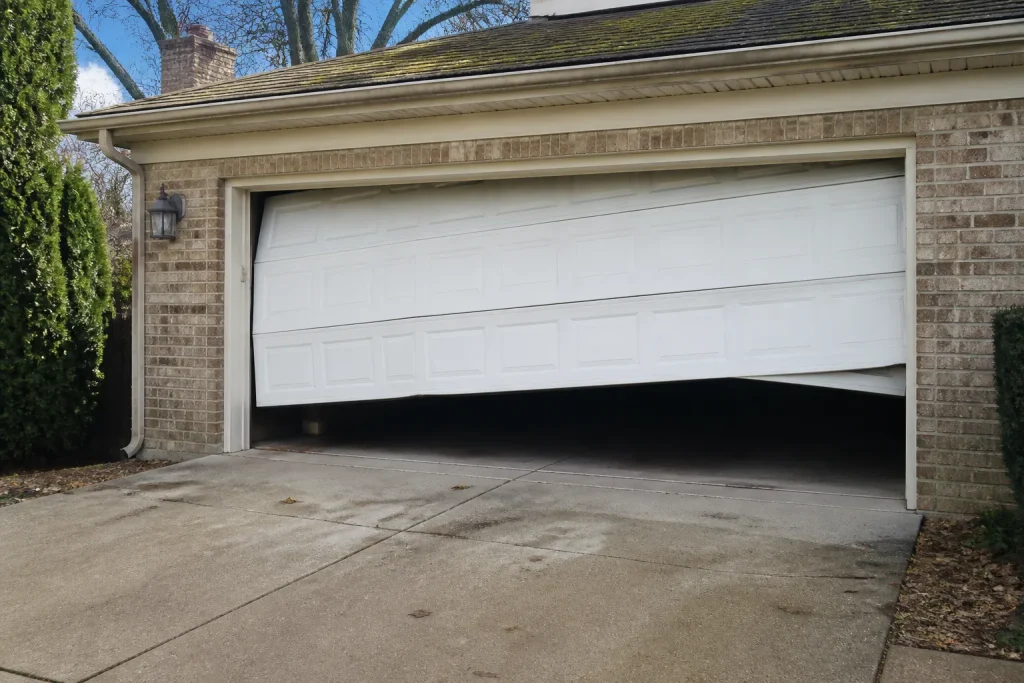
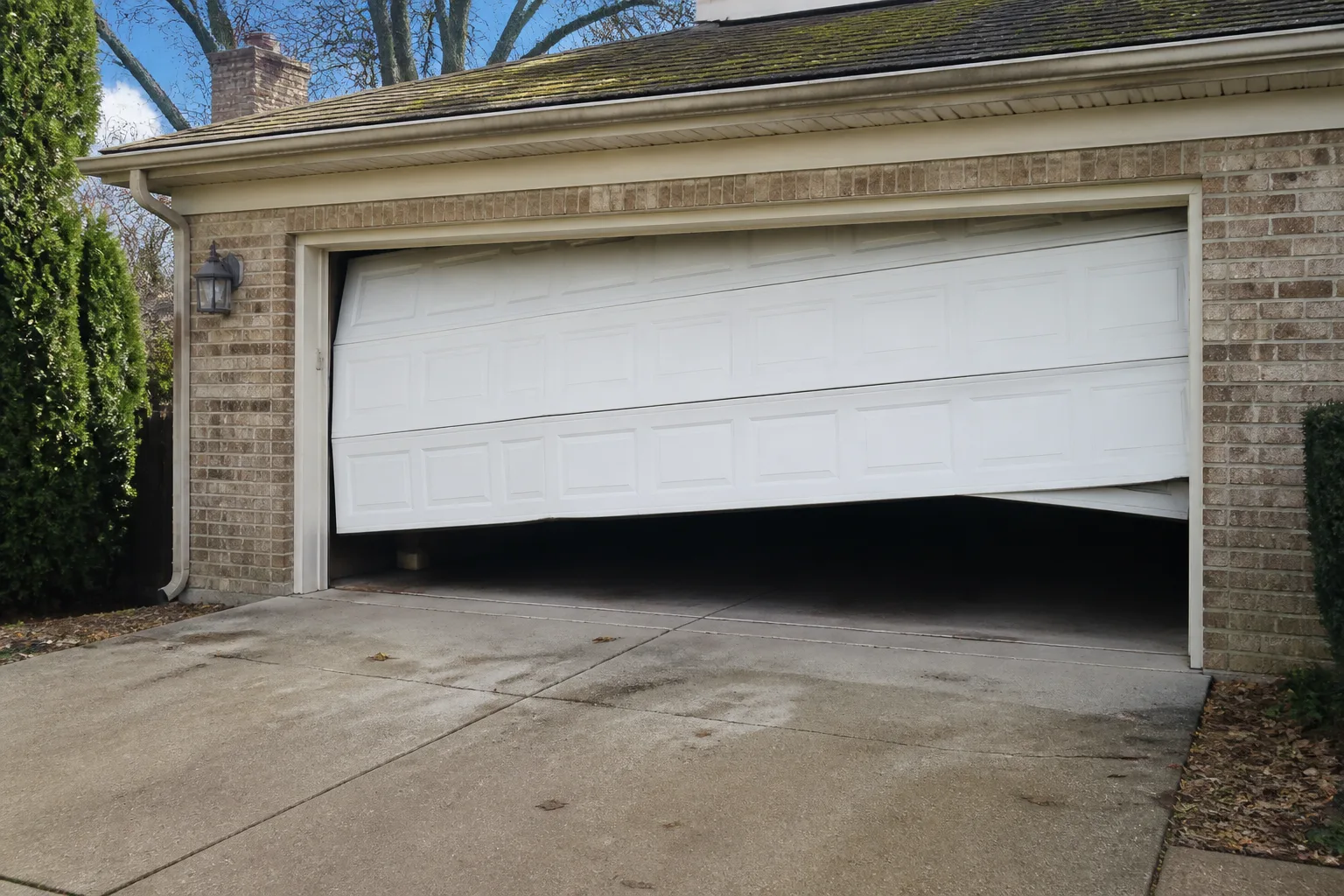
- A door that’s come off its track or hangs crooked and won’t travel straight. Forcing it further can bend panels and drop the door.
- A door that reverses, stops partway, or won’t close. A door that stops partway isn’t protecting anything. It needs diagnostics before it’s run again.
- Anything the door does that suggests it might fall. If it ever hesitates, drops, or looks like it wants to come down unevenly, keep people and cars clear of it.
Any of these qualify as an urgent repair. If a door fails on a Saturday and the house needs securing, call us at (844) 443-3746. We answer 24/7. A call outside dispatch hours is booked into the next opening, Sunday through Friday, 7am to 7pm. We’re closed on Saturday, so a weekend failure gets booked for Sunday rather than left sitting.
Why Brand Compatibility Matters When You Finally Call
When you do decide to get the door looked at, the next question is who to call. A garage door specialist who works across the brands you already own saves you the runaround of being told a part has to be special-ordered or that your system isn’t one they handle.
We’re trained and equipped to service LiftMaster, Chamberlain, Genie, Clopay, Amarr, Wayne Dalton, Craftsman, and Raynor. That matters in practice. If your door is a Clopay or a Wayne Dalton and your opener is a Genie or a LiftMaster, one company can work on both the door and the drive without a hand-off. We’re not a general handyman splitting attention across unrelated trades. Garage doors are all we do, and it’s a real advantage when you’re diagnosing whether an issue belongs to the door or the opener.
It also keeps you from calling two contractors. The same company that repairs a broken spring handles opener diagnostics, parts, and, when a door reaches the end of its life, garage door installation. One call covers everything.
The Bottom Line
The clearest way to read your garage door is by stage. Early signs (slow lift, light rattle, a seal that doesn’t sit flat) are usually small fixes. Mid-stage signs (opener strain, a door that drags, a balance test it fails) mean it’s time to stop guessing. Critical signs (a snapped spring, a frayed cable, a door off its track) mean stop using the door entirely until it’s repaired. The whole point of catching things early is that the early repair is the one you’ll forget about a week later, and the ignored one is the one that wakes you up at 6am.
If your door is somewhere on that timeline and you’re not sure which stage you’re in, we’d rather you ask than wait. If you’re in Norwood Park and need help, Garage Door Repair Norwood Park offers free estimates. You’ll get a written quote and a price agreed before any work starts, so there’s no surprise on the invoice. Call (844) 443-3746 to set it up. We answer 24/7.
Related services in Norwood Park: Our team handles Garage Door Repair Norwood Park for the urgent stuff, garage door repair for the everyday fixes, garage door opener repair for motor and sensor trouble, and garage door installation when a door has reached the end of the road.
Frequently Asked Questions
You need repair if the door’s structure is sound and the problem is in the springs, cables, rollers, track, or opener. You need to think about replacement if panels are rusted through, the door is badly bent, or it’s failing repeatedly and the repairs are adding up. Most issues we see in Norwood Park are repair jobs, not replacement, and a free estimate will tell you which one you’re facing.
A broken spring or a frayed cable is the most dangerous. Both are under extreme tension, and a door supported by a failed spring can drop hard. If the spring has snapped or a cable looks damaged, stop using the door and keep people and cars clear until a trained technician can look at it. Call (844) 443-3746 for an estimate.
A slow door is usually safe to monitor for a short time, but it’s not something to put off indefinitely. The slowness is often a spring losing tension and the opener compensating, and that added load shortens the opener’s life. If the door also binds or won’t hold its position in the balance test, stop using it and call. Call (844) 443-3746 for an exact quote; estimates are free.
The written estimate is the price, and we agree it with you before any work starts. If we find something extra once we’re in, we’ll show you what we found and quote it before touching it. No surprise invoices. Call (844) 443-3746. We answer 24/7. Fast dispatch from 7am to 7pm, Sunday through Friday.
Written by the team at Garage Door Repair Norwood Park.
Need Garage Door Help?
Call Garage Door Repair Norwood Park - the local pro we connect you with is licensed and insured, here with fast help in Norwood Park.
(844) 443-3746